





Introduction
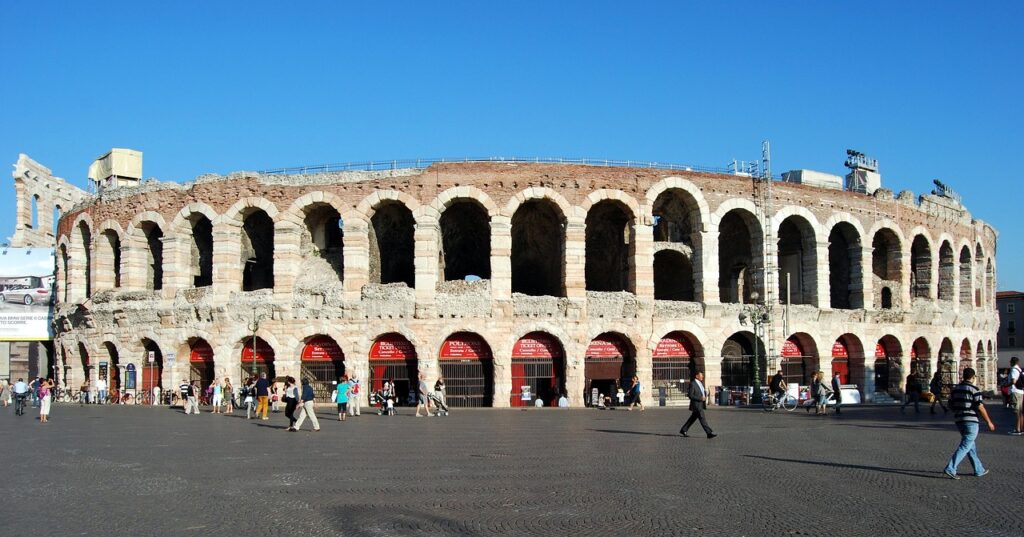
The Arena of Verona is one of Italy’s best-preserved Roman monuments and a living emblem of the city. Sitting at the heart of Piazza Bra, it draws hundreds of thousands of visitors each year who come to admire its imposing architecture, attend open-air operas, and dive into a story that stretches back to antiquity. This article walks you through the Arena’s evolution in ten stages—combining dates, exact locations, practical tips and essential visitor information so you can plan a visit or attend a performance with confidence.
Built in the 1st century AD, the Arena has survived the centuries: partial collapses, medieval rebuilds, transformations into a public square and a theatrical rebirth in the 19th century. Today it’s more than an archaeological relic; it’s a working theatre, widely renowned for its international opera festival each summer that turns the ancient structure into a spectacular stage for monumental productions.
In this ten-step guide you’ll not only learn the Arena’s architectural and social history but also find practical details: the exact address, typical opening hours, admission prices, opera ticket ranges, routes, nearby sights like Casa di Giulietta and Castelvecchio, plus local tips to get the most out of your visit (best times to go, access, safety, cafés and restaurants nearby). Each step includes an immersive narrative to place you at the center of events—from Roman market days to the thrill of a lyrical performance under Verona’s starry sky.
Before diving into the ten stages, here’s the essential info to plan your visit: the Arena of Verona is located at Piazza Bra, 1, 37121 Verona VR, Italy. Hours vary with season and events—generally the site is open to daytime visits from about 9:00 to 19:00 (indicative), and evening opera performances typically start between 20:00 and 21:00 during the summer season. Daytime admission for self-guided visits is usually around €10 to €12 for adults; opera ticket prices vary widely by seat category and production, typically from €20 up to more than €250 for premium seats. Leave time to enjoy Piazza Bra and its cafés, and consider quick stops at Casa di Giulietta (Via Cappello, 23, 37121 Verona VR) and Castelvecchio (Piazza Castelvecchio, 2, 37121 Verona VR).
 Click here to book your Arena skip-the-line guided tour
Click here to book your Arena skip-the-line guided tour

Stages 1 and 2: Roman foundation and early uses (1st century)
Stage 1 — Construction and original purpose
The Arena’s first stone was laid in the 1st century AD, probably during the reigns of Augustus or Vespasian. Built as a classic Roman amphitheatre, its elliptical form could hold tens of thousands of spectators. Originally the Arena hosted gladiatorial combats, venationes (animal hunts) and other public games—central expressions of Roman civic life. The use of local stone, notably limestone, gives the building its warm golden hue that you can still see today.
The chosen site—Piazza Bra—made the Arena easily accessible from the heart of the ancient city. From its earliest centuries the amphitheatre shaped Verona’s social and festive rhythms, acting as a focal point for a vibrant Roman culture. Archaeological digs and studies estimate its original capacity at between 20,000 and 30,000 spectators, depending on the period and subsequent modifications.

Stage 2 — Late antique adaptation and uses
By late antiquity the changing fortunes of the Roman Empire altered how the Arena was used. The decline of public games, the rise of Christianity and social upheavals reduced the frequency of spectacles. Nevertheless, the building remained a gathering place—sometimes used as a market square or for public assemblies. Parts of the seating were reused or incorporated into new urban constructions, a common fate for Roman monuments embedded in medieval towns.
Reused materials and piecemeal medieval interventions still form part of the structure’s stratigraphy: each stone tells a chapter, from occasional restorations to medieval brick repairs intended to stabilize vaults.
Stages 3 and 4: Middle Ages and Renaissance — recycling and revival
Stage 3 — Middle Ages: fortification and varied uses
During the Middle Ages the Arena became part of Verona’s medieval urban fabric. For defensive needs it was sometimes treated as a useful enclosure for local military maneuvers. Residents also used the space for practical purposes: storage, markets, or even as pens for livestock. These adaptations and the encroachment of surrounding buildings led to a partial loss of the original structure, but paradoxically they helped preserve it by keeping it in constant use.
Local records show successive interventions aimed at keeping the building functional, often with solutions that were not respectful of the ancient fabric but were necessary to ensure its survival. Over time Piazza Bra evolved into a lively public space—markets, fairs and civic processes found a natural setting here.
Stage 4 — Renaissance and the artistic rediscovery
With the Renaissance and a renewed interest in antiquity, the Arena gained intellectual and artistic prestige. Venetian and Veronese scholars and artists studied its proportions and architecture, inspiring restoration projects. Yet it wasn’t until the 19th century that the Arena experienced a theatrical rebirth: it was rediscovered as a venue for performances and especially for opera.
The first outdoor opera experiments were tentative, but the Arena’s grandeur soon lent itself to increasingly ambitious productions. Restoration work of that era focused on stabilizing the seating and highlighting the exterior façades to welcome a modern public.

Stages 5 and 6: 19th century — the era of open-air opera
Stage 5 — Birth of the lyric festival
The decisive turning point came in 1913 with a production of Aida staged to celebrate a local anniversary; but notable outdoor performances had already been put on during the 19th century. What propelled the Arena into legend was the scale of the productions and the surprisingly good acoustics despite the lack of a roof. Open-air opera became a Veronese signature, attracting renowned singers and directors.
Productions are known for monumental sets, large choruses and spectacular staging scaled to the amphitheatre. On opera nights spectators flock to the Arena: the seating lights up and the stage becomes a universal platform where Verdi, Puccini and other staples of the repertoire come to life.
Click here to book your opera tickets at the Arena
Click here to book opera tickets at the Arena

Stage 6 — Modern facilities and audience comfort
To meet contemporary needs the Arena was fitted with modern facilities: dressing rooms, updated ticketing, numbered seating in some sections, advanced stage lighting and crowd-safety systems. Renovations were carried out carefully to preserve archaeological integrity while offering a minimum level of comfort. The large stage now supports live broadcasting and hosts international productions.
Practical tip: if you plan to attend an opera, book your tickets in advance via the Arena’s official website or at the box office at Piazza Bra, 1. Prices vary widely: standing room or cheap side seats can start around €20, while boxes and prime numbered seats near the stage can exceed €200 for major productions. Opera evenings typically begin between 20:30 and 21:30 depending on the season; arrive at least 60 minutes before doors open to find your seat and soak up the atmosphere.
Stages 7 and 8: 20th century — protection and mass tourism
Stage 7 — Heritage protection and restoration
In the 20th century growing concern for heritage preservation led to more methodical and scientific restoration campaigns. Local authorities and international organizations funded work to stabilize the structure, treat deteriorated materials and document the ancient architecture. Interventions also aimed to regulate access and limit wear from heavy visitor traffic.
Archaeological projects uncovered buried elements and fragments of urban history that still enrich guided tours and temporary exhibitions. Site management evolved into a careful balancing act between live performances, conservation and cultural tourism.
Stage 8 — Contemporary tourism and sustainable visits
With travel becoming accessible to more people, the Arena became a major international destination. Verona’s tourist offices now encourage responsible visitation: approach the Arena on foot from the train station (Verona Porta Nuova) or use public transport to reduce congestion. The city offers combined tickets that include other attractions: Castelvecchio (Piazza Castelvecchio, 2), Casa di Giulietta (Via Cappello, 23) and the Lapidary Museum (Museo Lapidario Maffeiano, Piazza Bra, 28).
Indicative prices for nearby museums: Castelvecchio Museum — around €6 to €8, Casa di Giulietta — variable entrance fees around €6. Hours: most museums open roughly from 9:00 to 18:00; check current schedules before planning. To avoid crowds at the Arena, favor an early-morning visit (opening around 9:00) or admire the façade at sunset from Piazza Bra.
Click here to buy the City Card with priority Arena entry
Click here to purchase the Verona City Card with priority Arena entry

Stages 9 and 10: 21st century — modern events, innovations and the future
Stage 9 — Cultural and technical innovations
In the 21st century the Arena adapted to new technologies: live streaming of select performances, digital scenography and advanced sound and lighting systems. Programming has diversified: beyond opera, pop concerts, international cultural events and multimedia shows now occupy the space, drawing a broader audience.
Conservation authorities still limit the impact of certain events. Procedures are in place to control set weights and fixings to protect the monument. Visitors are expected to follow strict rules: no climbing on the seating, no littering, and adherence to safety instructions during major events.

Stage 10 — Future outlook and challenges
Looking ahead, the Arena’s future depends on balancing live performance, sustainable tourism and heritage preservation. Challenges include managing visitor flows, adapting to climate change (stone conservation and preventing water infiltration), and passing the site’s story on to new generations. Educational initiatives—like themed guided tours and workshops for children—play an important role in that mission.
Practical tips for future visitors: buy performance tickets in advance; check the Arena’s official website for exact times and exceptional closures; wear comfortable shoes for climbing the seating and exploring the surroundings; and pick morning or late-afternoon slots for the best light for photos.
Conclusion
The Arena of Verona is a fascinating historical palimpsest: from its origins as an ancient entertainment and funerary monument to its role today as a grand lyrical stage, every stone records cultural and social transformations. Tracing its history in ten stages we’ve covered more than two millennia of urban life, reuse, rediscovery and reinvention. The iconic address—Piazza Bra, 1, 37121 Verona VR, Italy—remains a must-visit not only for architecture and opera lovers but for anyone wanting to see how a place can reinvent itself without losing its soul.
To plan your visit: expect a self-guided entry fee around €10–€12, or book opera seats through the official box office with prices ranging from €20 to over €250 depending on category; always check current opening hours (visits often run from 9:00 to 19:00, and evening performances usually start from around 20:30 in season). Also take advantage of nearby attractions: Casa di Giulietta (Via Cappello, 23) for a romantic stop and Castelvecchio (Piazza Castelvecchio, 2) for a dive into Verona’s art and history collections.
Final practical tips: arrive early to avoid crowds, bring a small bottle of water (summers can be hot), remember sunscreen and a hat for outdoor performances, and respect conservation rules. Above all, leave time to wander Piazza Bra, enjoy a coffee on a terrace, and listen to the echoes of the past that still resonate among the Arena’s stones. That way your visit becomes more than an architectural stop—it becomes a true immersion in Verona’s long, living history.

