





Introduction
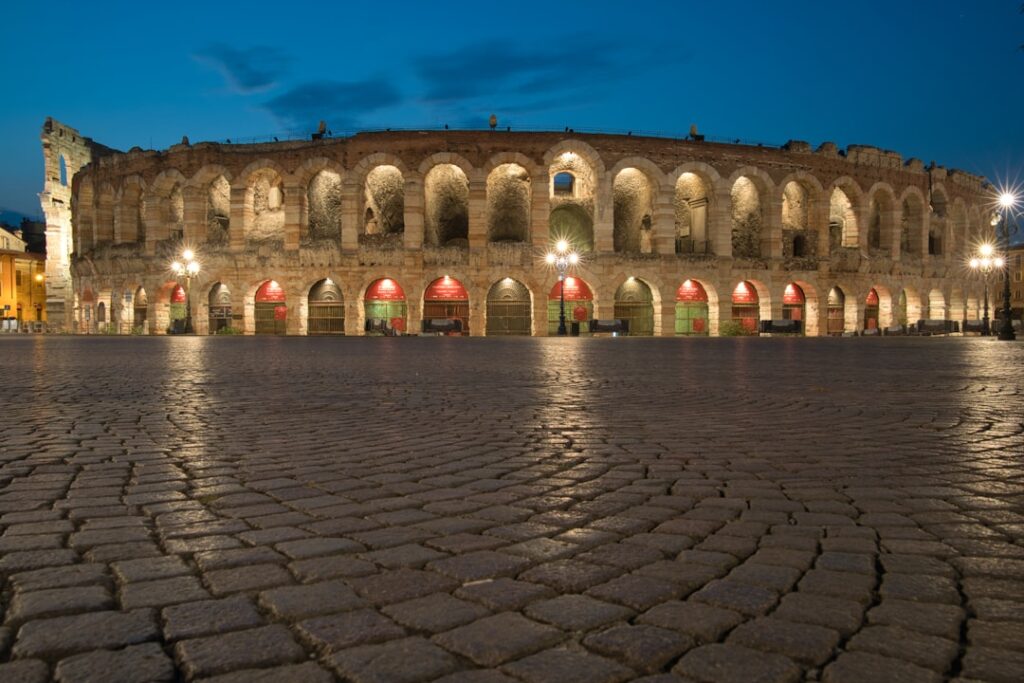
Verona is often linked to Romeo and Juliet, medieval streets and elegant Venetian palaces. But at the heart of this city stands a monument that captures the imagination of millions of visitors each year: the Arena di Verona. This open-air Roman theatre, built in the 1st century AD, is one of the best-preserved ancient amphitheatres in the world and remains a living venue where architectural history meets contemporary cultural events. Walking across Piazza Bra and spotting the Arena’s massive silhouette immediately sparks a sense of wonder — a blend of Roman echoes and modern spectacle.
For the curious traveler, the Arena is more than just a landmark: it’s a multisensory experience. The extraordinary acoustics, stone weathered by centuries of exposure, and the tiers filled with stories give every visit a unique atmosphere. Whether you love history, music, photography or simply want an unmissable stop on an Italy itinerary, a trip to the Arena offers clear and convincing reasons to add Verona to your travel list.
In this article, we explore the seven main reasons the Arena di Verona deserves a dedicated visit. We’ll describe the architecture and history, the opera and concert experience, practical planning tips, nearby gems like Piazza Bra, Palazzo Barbieri and the famed Casa di Giulietta, plus local advice to get the most from your day. Expect exact addresses, typical opening hours, ticket prices and hands-on tips — everything you need to turn curiosity into an unforgettable visit.
Before we dive in, imagine this: at dusk the lights gently illuminate the golden stone, thousands of spectators take their seats and a lyrical voice rings out against the ancient tiers. It’s that magic — the amazing mix of old and alive — that forms the true soul of the Arena di Verona.
 Click here to book a skip-the-line guided Arena visit

The history and architecture of the Arena di Verona
The Arena di Verona was erected in the 1st century AD during the Roman Empire, around the years 30 BC–30 AD. Its remarkable state of preservation is due to a long history of adaptive reuse: over the centuries the amphitheatre has hosted performances, served as a fortress and been integrated into the urban fabric. Unlike other ancient monuments that collapsed or were dismantled, the Arena has retained much of its elliptical ashlar stone structure. Its outer façade — now partially ruined — once featured three superimposed tiers of arches. You can still see massive sections of the façade and the ring of inner seating, testimony to exceptional construction skill.
The interior architecture is just as fascinating: the central stage area and stone tiers once held an estimated capacity of more than 20,000 spectators in antiquity. Today, for safety and comfort, the Arena welcomes around 15,000 people for major summer performances. The boxes, access points and crowd circulation system reveal the efficiency of Roman planning — even though medieval and modern rearrangements have altered some entrances.
Observing the materials helps you understand the site: the local limestone, polished by centuries, shows shades of cream and gold. The stone’s texture, marked by wear from footsteps and weather, conveys a tangible sense of age. Successive restorations have aimed to preserve the original character while ensuring stability and safety for modern visitors.
On a symbolic level, the Arena illustrates continuity between antiquity and modernity: a monument originally dedicated to combat, public spectacles and social rituals has been transformed into a temple of music and culture. It’s this historical layering that makes a visit so rich: you don’t just see ruins, you experience a living structure used and loved for two millennia.
Click here to book a gladiator-era Arena tour

Key historical and architectural facts
- Construction date: 1st century AD (around 30 BC–30 AD).
- Historical capacity: up to 20,000 spectators (estimates).
- Materials: local limestone, ancient mortar, modern restorations.
- Structure: elliptical shape, concentric seating tiers, central arena.
Opera and programming: spending an evening at the Arena di Verona
The Arena di Verona is famous for its opera festival — the « Festival Arena di Verona » — which animates the city each summer since 1913. Attending a lyrical performance in this ancient amphitheatre is a unique experience: the mix of natural acoustics, monumental stage design and powerful voices creates unforgettable evenings. Productions are often grand in scale, with imposing sets, lavish costumes and spectacular direction tailored to the venue.
The operas most frequently staged include Italian classics like Aida, La Traviata, Il Trovatore and Turandot. Performances attract an international audience and can last several hours — so plan on comfortable clothing and arrive early to find your seat, especially if you hold a general admission bleacher ticket.
Ticket prices vary widely by location: for an opera you can find seats starting at around €25 for the upper bleachers, while boxes and seats closer to the stage can exceed €200–€300 depending on the event and demand. It’s best to buy official tickets through the Arena’s box office or accredited sellers: unofficial tickets can be severely marked up.
For concerts and special events (pop, rock, contemporary music), prices also vary: they typically start around €30–€40 for general admission and rise depending on the artist and stage setup.
Practical tips for an evening at the Arena:
- Arrive early: allow at least 45–60 minutes before the start to clear security and get seated.
- Clothing: bring a layer for the evening — even in summer nights can turn cool.
- Food: there are kiosks and food points nearby, but they can get crowded; consider dining earlier if you prefer a seated meal.
- Transport: Piazza Bra can be pedestrianised and busy; walk from the historic center or use public transport.
- Accessibility: accessible seating is available for people with reduced mobility, but book these spots in advance via the box office.
Click here to book your opera tickets at the Arena
Visiting the Arena: address, opening hours, prices and practical tips
To plan your visit, here are the essential practical details for the Arena di Verona. Official address and reference point:
Address: Arena di Verona, Piazza Bra, 1, 37121 Verona VR, Italy.
Opening hours (tourist visits): in the tourist season (spring/summer), the Arena is generally open for daytime visits from 8:30 to 19:30, with variations depending on events and public holidays. In winter, hours are reduced — common opening times are between 9:00 and 17:00. For evening performances, doors often open 90 to 60 minutes before the show. These times can change yearly: check the official box office for up-to-date information.
Indicative prices:
- Arena tourist entry (self-guided visit): around €10 for adults, reduced rate €7 for youth/students/seniors (with ID where required).
- Opera tickets: from about €25 for upper bleacher seats; average prices €50–€150; premium seats >€200.
- Group rates and guided tours: available and can offer better value; expect supplements for official guides.
Box office and contacts: the box office is usually located on one side of Piazza Bra; for opera programming and bookings use the Arena’s official box office (there’s an on-site counter and online booking options). Lines can be long in high season: book in advance whenever possible.
Practical tips for the visit:
- Quiet hours: visit early in the morning (or right after opening) to avoid crowds and enjoy soft light for photography.
- Shoes: wear comfortable, slip-resistant footwear — the stone tiers can be uneven.
- Bags: some events have restrictions on bag size and permitted items; for day visits a light backpack is ideal.
- Audio guides: sometimes available in several languages; a good option if you want full historical context without a private guide.
- Photography: allowed for personal use; natural light makes all the difference — look for angles that show the scale of the amphitheatre.
Click here to book your skip-the-line Arena ticket

The surroundings: Piazza Bra, Palazzo Barbieri and Casa di Giulietta
The Arena doesn’t stand alone: it occupies a prime spot on Piazza Bra, one of Italy’s largest urban squares. This wide esplanade is lined with cafes, restaurants and trees, and is the perfect starting point for exploring Verona’s historic center.
On Piazza Bra you’ll also find the Palazzo Barbieri (Palazzo Barbieri, Piazza Bra, 1, 37121 Verona VR) — the neoclassical city hall building that serves as Verona’s municipal seat today. Its imposing façade and balconies lend an official air to the square. On the opposite side, the arcades along the piazza host historic cafes and terraces ideal for watching the Arena while enjoying an espresso or a spritz.
A short walk away is the famous Casa di Giulietta (Casa di Giulietta, Via Cappello, 23, 37121 Verona VR). Although its real connection to Shakespeare’s Capulet family is legendary rather than historical, the house draws visitors for its romantic balcony, love graffiti on the walls and the statue of Juliet in the courtyard. It’s a near-mandatory stop for many who visit Verona.
For lovers of religious architecture, the Cattedrale di Santa Maria Matricolare (Cattedrale di Verona, Piazza Duomo, 1, 37121 Verona VR) and the Basilica of San Zeno Maggiore (Basilica di San Zeno Maggiore, Piazza San Zeno, 2, 37123 Verona VR) offer complementary artistic and spiritual experiences, with frescoes, Romanesque portals and luminous interiors.
Tips to plan a full day:
- Morning: start with the Arena interior visit before the crowds arrive.
- Noon: have lunch in one of the trattorie around Piazza Bra or in the medieval lanes to taste Venetian and Veneto specialties (risotto all’Amarone, pasta with ragù, polenta).
- Afternoon: visit Casa di Giulietta and the Duomo, then stroll along the Adige River for picturesque views.
- Evening: return to the Arena for a performance, or choose a restaurant overlooking the piazza to enjoy the evening lights.
Click here to reserve a skip-the-line Juliet’s House ticket
Click here to book a combined Arena and Juliet’s House tour

6 local tips and tricks to make the most of the Arena
To turn an ordinary visit into a memorable experience, here are trusted local tips that take seasonality, logistics and common sense into account.
Tip #1: Plan by season: summer is peak season for opera and concerts; expect crowds and higher accommodation prices. Spring and autumn offer milder weather, fewer people and more affordable rates. In winter the Arena remains photogenic but some indoor areas may be closed.
Tip #2: Buy tickets in advance: for shows, book weeks or even months ahead. For sightseeing, tickets are usually available on site but online booking will save you time in line.
Tip #3: Handle logistics: Piazza Bra is easily walkable from Verona Porta Nuova station (about 15–20 minutes) or reachable by local buses. If you arrive by car, know that the historic center often restricts traffic; use peripheral parking and walk in.
Tip #4: Safety and comfort: look after your belongings — major tourist sites attract pickpockets. Stay hydrated, especially in summer, and seek shade on the piazza.
Tip #5: Photography and respect: the Arena is a living monument. During rehearsals and performances follow silence and photography rules. For great photos aim for sunrise or sunset: the stone turns an irresistible warm hue.
Tip #6: Explore beyond the crowds: wander the small adjacent streets to find artisanal shops, local patisseries and quiet squares where locals gather.
Click here to buy the City Card with priority Arena entry
Conclusion
The Arena di Verona is far more than a spectacular ruin: it’s a living place, rooted in history and today’s culture. Whether you’re drawn to its Roman architecture, the power of lyrical voices during an opera, or the vibrant atmosphere of Piazza Bra, the Arena delivers a range of experiences that fully justify a thorough visit. The reasons to come are many: its exceptional state of preservation that tells two millennia of history, the artistic programming that turns stone into stage, the quality of the nearby sights — palaces, cafes, legendary houses — and the ease with which you can include the site in a wider Veneto itinerary.
In practical terms, prepare your visit by checking updated hours and prices, booking tickets for popular shows in advance, and taking a few local precautions (comfortable shoes, sun protection, awareness of peak times). The recommendations we shared about the best seasons, photographic angles and nearby must-sees will help turn a simple stop into a deep dive into Verona’s soul.
Finally, remember that the Arena di Verona is meant to be experienced, not just admired from afar. Attending a concert or an opera there is to hear the echo of a civilisation and share a collective moment with thousands in an amphitheatre built over 2,000 years ago. If you’re planning a trip to Italy, reserving at least an evening or a morning at the Arena should be a priority — because this place, through its history, acoustics and setting, creates a travel memory that lingers long after you’ve returned home.